
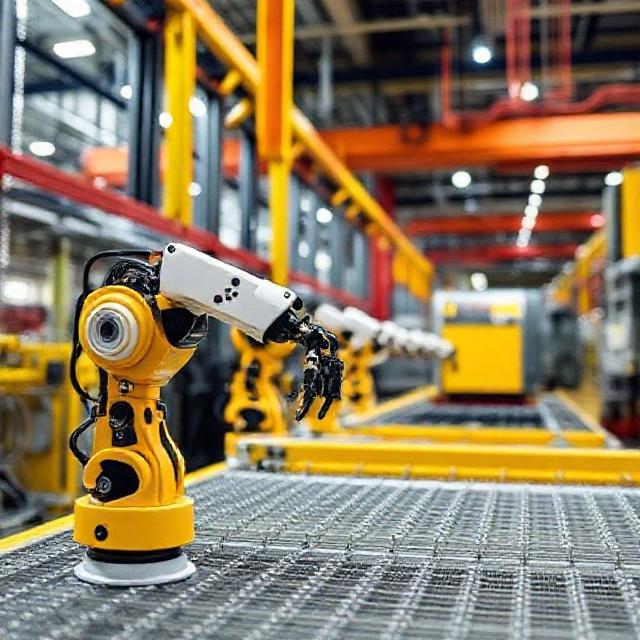
Manufacturing has always been at the forefront of automation, but recent advances in robotics, sensors, and artificial intelligence are driving a transformation that goes well beyond the repetitive assembly-line robots that have populated factories for decades. This new wave of manufacturing robotics is more flexible, more collaborative, and increasingly capable of handling tasks once thought to require human dexterity and judgment.
Traditional industrial robots excelled at repetitive, precisely defined tasks in controlled environments — welding car frames, painting components, or performing consistent assembly operations. These robots typically operated in isolated areas, separated from human workers for safety reasons, and required extensive programming for each specific task. Modifying their function for a new product line often meant significant downtime and reprogramming effort.
The emerging generation of manufacturing robots, often called collaborative robots or "cobots," is designed to work alongside human workers safely, using sensors that detect proximity and automatically adjust movement to avoid collisions. This allows for more flexible factory layouts where humans and robots share workspace, each contributing their respective strengths — robots handling repetitive, precise, or physically demanding tasks, while humans handle judgment-intensive activities requiring adaptability and nuanced decision-making.
Machine learning has also transformed how robots handle variability. Traditional robots struggled with tasks involving irregular objects — picking items of varying shapes and sizes from a bin, for instance, remained a persistent challenge for decades. Computer vision combined with reinforcement learning has made significant progress on these "unstructured" tasks, allowing robots to identify, grasp, and manipulate objects with far greater versatility than previous generations of hardware could manage.
This flexibility has particular value for smaller manufacturers producing customized or low-volume products, where the economics of traditional automation rarely justified the investment. Reconfigurable robotic systems that can be reprogrammed relatively quickly for new tasks make automation increasingly viable for businesses beyond the large-scale, high-volume manufacturers who have traditionally dominated robotics adoption.
Quality control has also benefited substantially from robotics integration with computer vision and machine learning. Automated inspection systems can now detect defects with precision that often exceeds human capability, operating continuously without the fatigue-related lapses that affect even the most diligent human inspectors. This has proven particularly valuable in industries like electronics manufacturing and pharmaceutical production, where defect detection carries significant safety and financial consequences.
Labor market implications of this manufacturing transformation remain a subject of ongoing debate. While automation displaces certain categories of repetitive manual labor, it also creates demand for workers skilled in robot maintenance, programming, and oversight. Manufacturing employment has shifted rather than simply disappeared, with growing demand for technically skilled workers even as the overall number of purely manual assembly positions has declined in many regions.
Supply chain resilience has become an additional motivation for manufacturing automation investment, particularly following widespread disruptions that highlighted vulnerabilities in globally distributed manufacturing networks. Companies increasingly view robotics-enabled automation as a way to bring manufacturing capacity closer to end markets, reducing dependence on distant supply chains while maintaining cost competitiveness through efficiency gains rather than relying solely on low-cost labor in distant locations.
As robotics technology continues advancing, the line between purely automated and purely human-operated manufacturing continues to blur, giving rise to increasingly sophisticated hybrid systems that leverage the complementary strengths of both human workers and increasingly capable robotic systems.





Comments