
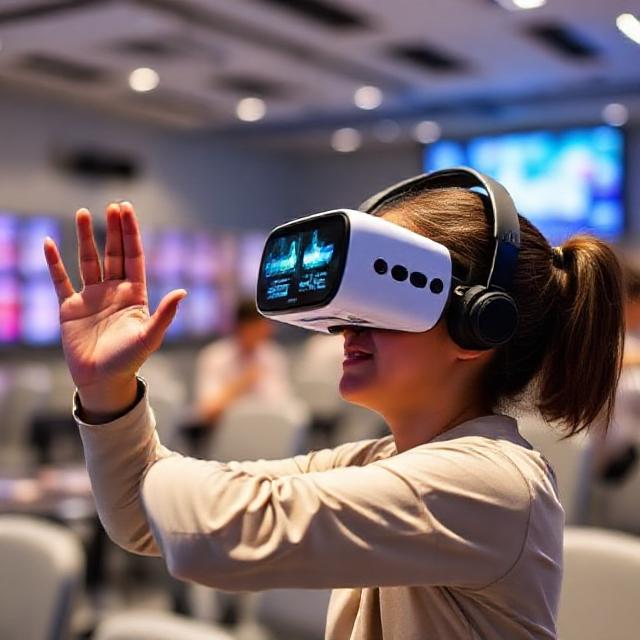
While consumer virtual reality has faced a bumpier path toward mainstream adoption than initially predicted, VR technology has found more consistent and compelling success within education and professional training contexts, where its unique ability to simulate realistic, immersive scenarios offers genuine advantages over traditional training methods.
Medical education represents one of the most well-established applications of VR training technology. Medical students and practicing physicians use VR simulations to practice surgical procedures repeatedly in a risk-free environment before ever operating on an actual patient. These simulations can recreate rare or complex surgical scenarios that a trainee might not otherwise encounter frequently enough during traditional training to build genuine proficiency, and can provide detailed performance feedback that helps identify specific areas needing improvement.
Aviation training has long used flight simulators, and modern VR technology has extended similar principles to a broader range of training scenarios beyond just cockpit operations. Airlines and aviation authorities use VR to train cabin crew for emergency procedures, allowing realistic practice of evacuation scenarios and emergency response protocols without any of the safety risks or costs associated with physical drills using actual aircraft.
Industrial and manufacturing training has also embraced VR extensively, particularly for hazardous environments where mistakes during real-world training could result in serious injury. Workers can practice operating dangerous machinery, responding to equipment malfunctions, or navigating hazardous environments like confined spaces or high-voltage electrical systems, building familiarity and confidence before ever facing these situations in reality.
Soft skills training has found somewhat unexpected but genuinely valuable VR applications as well. Companies use VR simulations to help employees practice difficult conversations, such as delivering negative performance feedback or handling customer complaints, allowing repeated practice with realistic virtual characters that respond dynamically to different approaches. Some research suggests that practicing these interpersonal scenarios in an immersive virtual environment, where a user genuinely feels present in the simulated situation, may produce better skill transfer than traditional role-playing exercises or passive training videos.
Special education has also found meaningful VR applications, with some programs using VR to help students with autism spectrum conditions practice social interactions and navigate potentially overwhelming sensory environments in a controlled, adjustable virtual setting before encountering similar situations in real life. This application takes advantage of VR's ability to precisely control environmental variables in ways that would be difficult or impossible to replicate consistently in physical training environments.
Higher education institutions have increasingly incorporated VR into specialized coursework, particularly in fields like architecture, where students can walk through and evaluate three-dimensional building designs at full scale before construction, or in history and archaeology courses, where VR reconstructions allow students to virtually explore historical sites or ancient structures that may be inaccessible, dangerous to visit, or no longer exist in their original form.
Despite these successes, VR training adoption still faces practical obstacles, including the upfront cost of headsets and content development, occasional issues with motion sickness affecting some users, and the ongoing challenge of demonstrating clear return on investment compared to traditional training methods for organizations considering the technology. As headset costs continue declining and content creation tools become more accessible, allowing organizations to build custom training scenarios without requiring specialized technical expertise, VR training is likely to expand into an increasingly broad range of educational and professional development contexts beyond its currently well-established niches.





Comments