
What Is Cloud Computing and Why Does Everyone Use It?
You've heard the phrase 'it's
saved in the cloud' dozens of times. But what does that actually mean? Cloud
computing has become the invisible backbone of modern digital life — from
streaming your favorite shows to running billion-dollar enterprises.
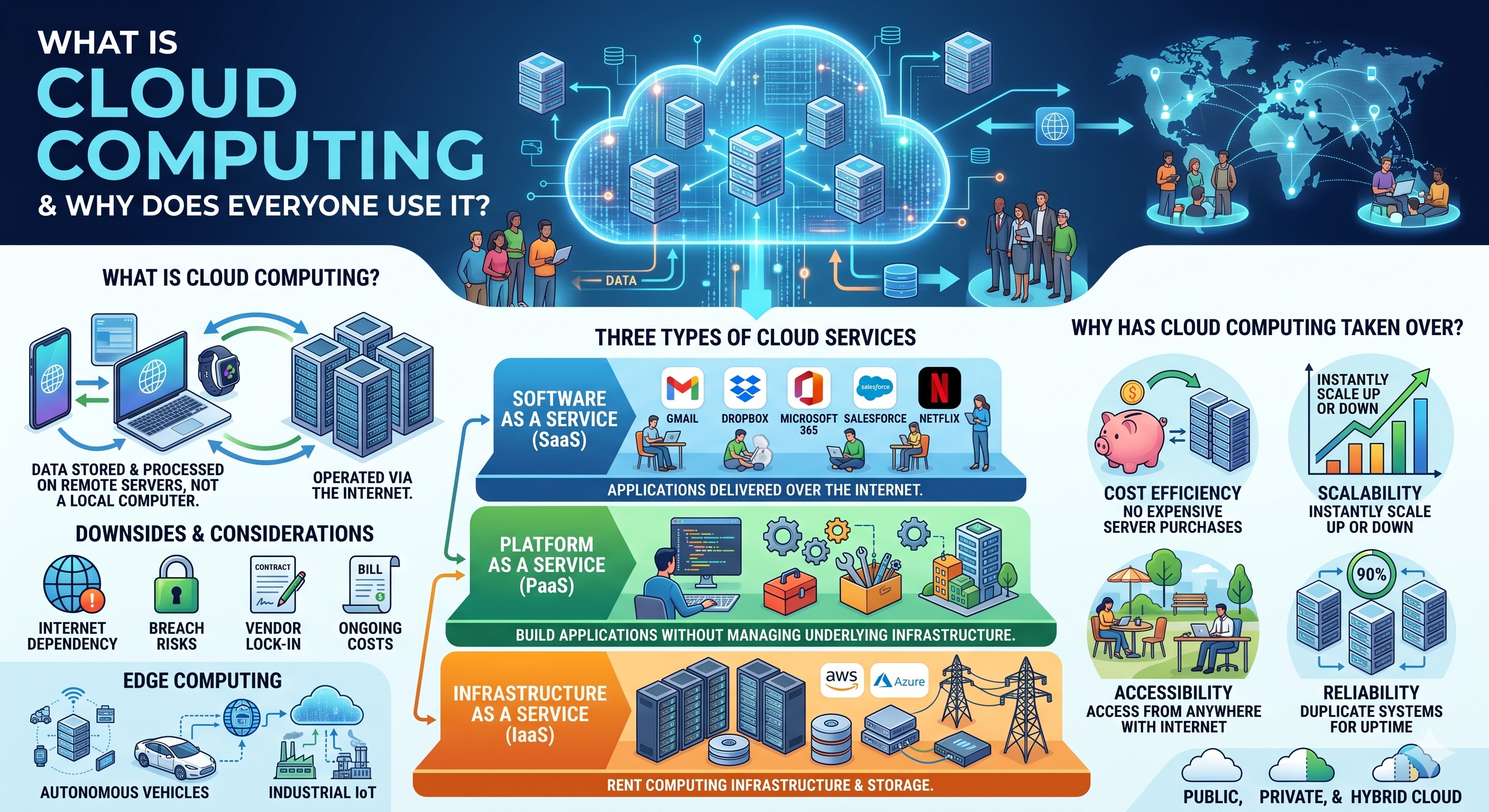
What Is the Cloud?
The cloud is simply a network of
remote servers hosted on the internet that store, manage, and process data —
instead of a local server or personal computer. When you save a photo to Google
Photos or stream a movie on Netflix, you're using the cloud.
Three Types of Cloud Services
Infrastructure as a Service
(IaaS) — renting computing infrastructure like servers and storage. Amazon Web
Services and Microsoft Azure are leading providers.
Platform as a Service (PaaS) —
tools and environments for developers to build applications without managing
the underlying infrastructure.
Software as a Service (SaaS) —
applications delivered over the internet. Gmail, Dropbox, Salesforce, and
Microsoft 365 are all SaaS products.
Why Has Cloud Computing Taken Over?
Cost efficiency: Companies no
longer need to buy and maintain expensive physical servers. Scalability:
Resources can be scaled up or down instantly based on demand. Accessibility:
Data and applications are available from anywhere with an internet connection.
Reliability: Cloud providers offer redundancy and uptime guarantees that most
businesses couldn't match on their own.
Public, Private, and Hybrid Cloud
Public cloud services are shared
infrastructure offered by providers like AWS, Google, and Microsoft. Private
cloud is dedicated infrastructure for a single organization. Hybrid cloud
combines both — keeping sensitive data on private infrastructure while using
public cloud for other workloads.
The Downsides of Cloud Dependence
Cloud computing isn't without
risks. Internet outages mean no access to data. Security breaches at major
providers can affect millions. Vendor lock-in can make switching providers
difficult and costly. And ongoing subscription costs can add up significantly
over time.
The Future of Cloud
Edge computing — processing data
closer to where it's generated rather than in centralized data centers — is
emerging as a complement to cloud computing, reducing latency for
time-sensitive applications like autonomous vehicles and industrial IoT.





Comments