
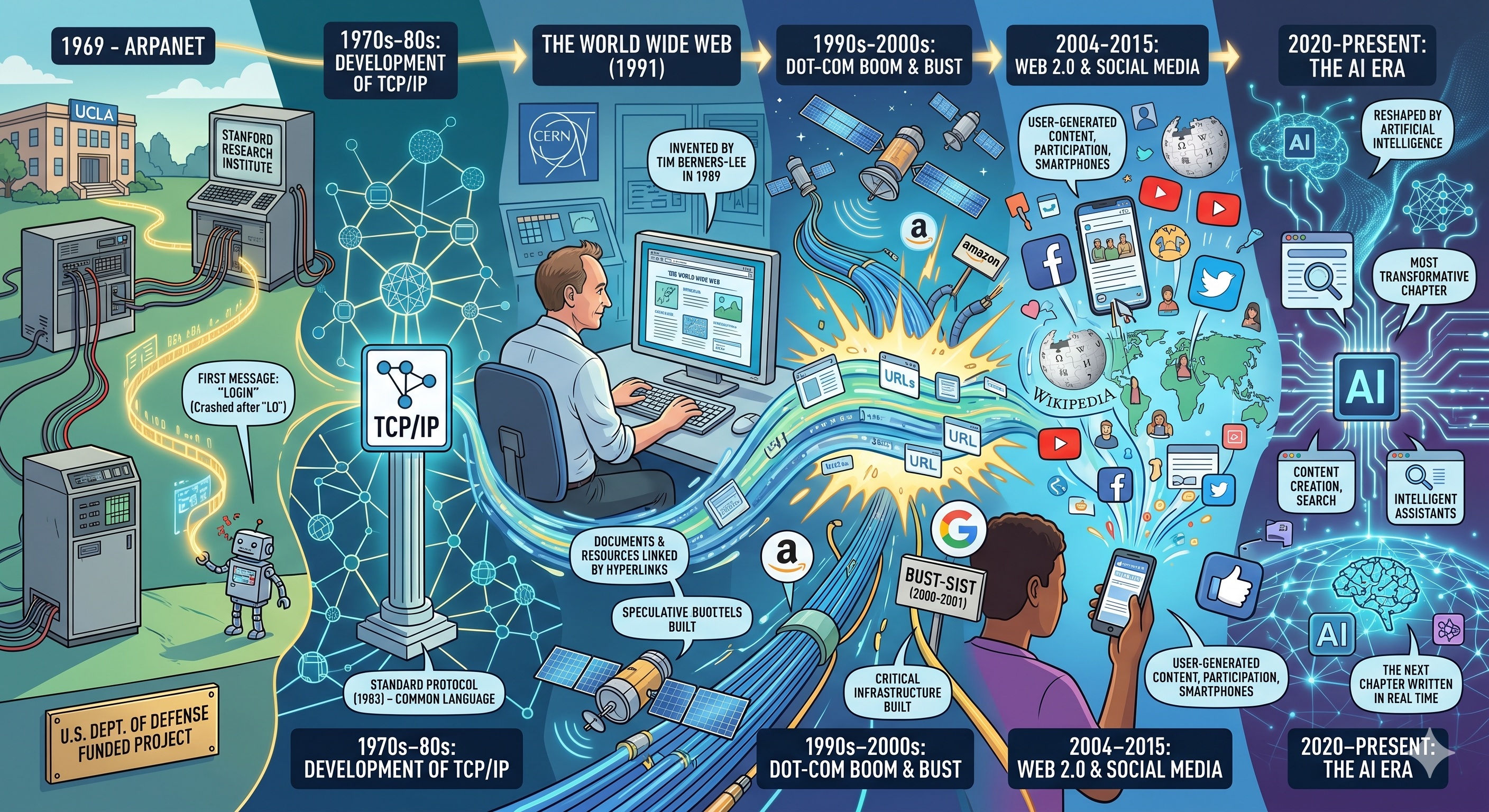
The History of the Internet: From ARPANET to the AI Era
The internet is so woven into
daily life that it's hard to imagine the world without it. But it had a
beginning — a specific moment when a handful of computers first communicated
across a network. Here's the story of how the internet was born and grew to
connect the world.
The Birth of ARPANET (1969)
The internet's origins trace to
ARPANET — a project funded by the U.S. Department of Defense's Advanced
Research Projects Agency. On October 29, 1969, the first message was sent
between computers at UCLA and Stanford Research Institute. The system crashed
after two letters ('LO' — the beginning of 'LOGIN'), but a new era had begun.
The Development of TCP/IP (1970s–80s)
Through the 1970s and 80s, the
fundamental protocols that underpin the internet were developed. TCP/IP
(Transmission Control Protocol/Internet Protocol), standardized in 1983, became
the common language that allowed different networks to communicate — the true
foundation of the modern internet.
The World Wide Web (1991)
The internet and the web are
different things. The web — invented by Tim Berners-Lee at CERN in 1989 and
launched publicly in 1991 — is a system of documents and resources linked by
hyperlinks and accessible via the internet. The browser made the internet
visual and navigable for everyday people.
The Dot-Com Boom and Bust (1990s–2000s)
The late 1990s saw explosive
growth in internet companies — and a speculative bubble. The dot-com bust of
2000–2001 wiped out trillions in market value but left behind critical
infrastructure, companies like Amazon and Google, and lessons that shaped the
next generation of the web.
Web 2.0 and Social Media (2004–2015)
The second era of the web was
defined by user-generated content and social networks. Facebook, YouTube,
Twitter, and Wikipedia transformed the internet from a publishing platform into
a participatory medium. Smartphones then put this connected world in everyone's
pocket.
The AI Era (2020–Present)
Today, the internet is being
reshaped by artificial intelligence — from search to content creation to how we
interact with digital systems. The next chapter of the internet's story is
being written in real time, and it may be the most transformative yet.





Comments