
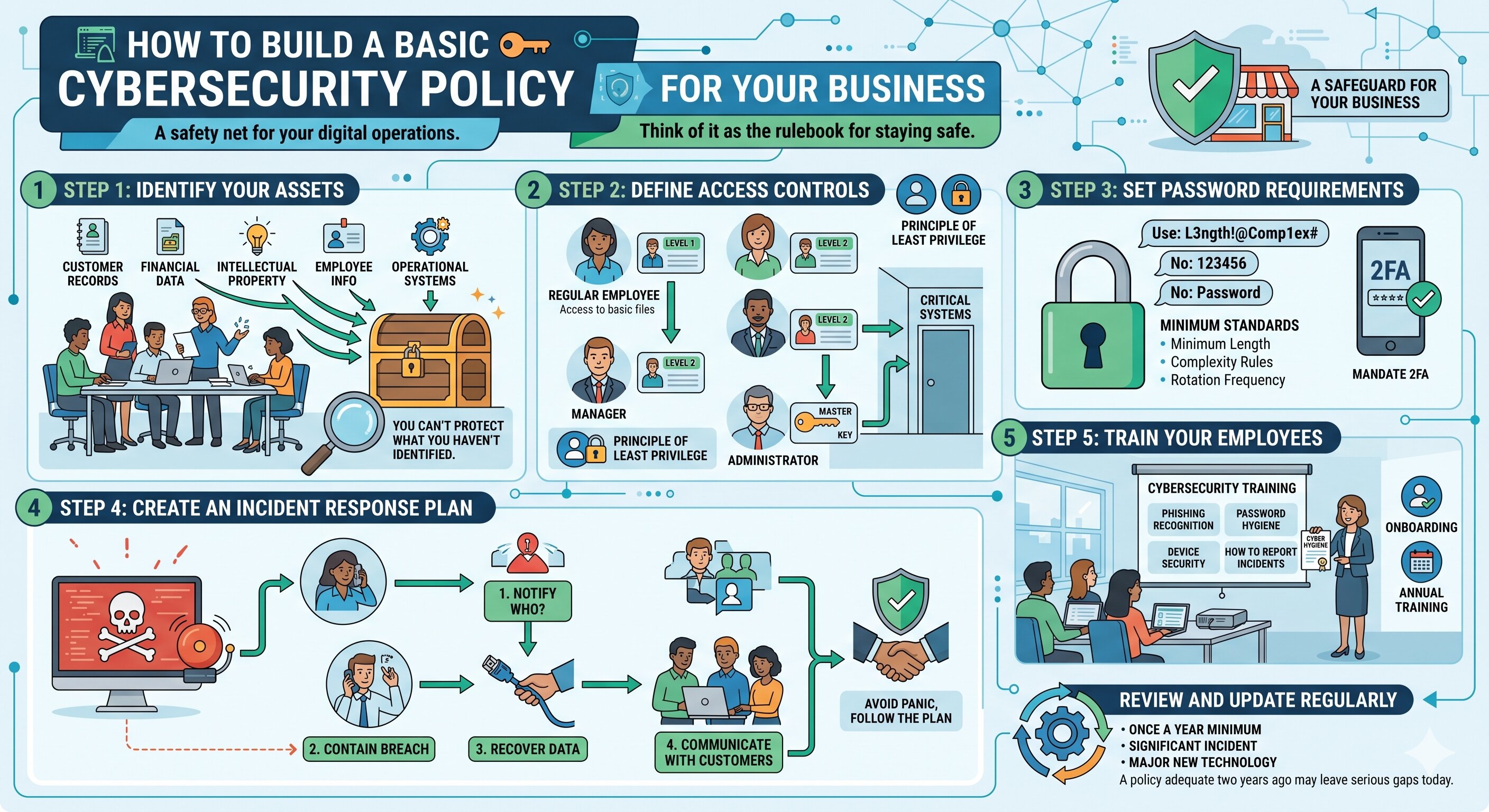
How to Build a Basic Cybersecurity Policy for Your Business
If your business doesn't have a
cybersecurity policy, you're operating without a safety net. A policy doesn't
need to be complex — but it needs to exist. Here's how to build one from
scratch.
What Is a Cybersecurity Policy?
A cybersecurity policy is a
written document that defines how your organization will protect its digital
assets. It outlines rules for employee behavior, data handling, access control,
incident response, and more. Think of it as the rulebook for staying safe.
Step 1: Identify Your Assets
What data and systems does your
business depend on? Customer records, financial data, intellectual property,
employee information, and operational systems are all assets that need
protection. You can't protect what you haven't identified.
Step 2: Define Access Controls
Not everyone in your company
needs access to everything. Apply the principle of least privilege — employees
should have access only to what they need to do their job. This limits the
damage if an account is compromised.
Step 3: Set Password Requirements
Define minimum password
standards: length requirements, complexity rules, and how often passwords
should be changed. Mandate the use of 2FA for all critical systems.
Step 4: Create an Incident Response Plan
What happens if you're hacked?
Define clear steps: who to notify, how to contain the breach, how to recover
data, and how to communicate with affected customers. Having a plan before an
incident dramatically reduces the damage.
Step 5: Train Your Employees
A policy is useless if people
don't know about it. Conduct regular training — at onboarding and annually at
minimum — covering phishing recognition, password hygiene, device security, and
how to report incidents.
Review and Update Regularly
Cyber threats evolve constantly.
Review your policy at least once a year — and whenever a significant incident
occurs or major new technology is introduced. A policy that was adequate two
years ago may leave serious gaps today.





Comments