
Starlink and the Race to Bring Internet to Everyone on Earth
For all the talk of the
connected world, roughly a third of the global population remains without
reliable internet access. A new generation of satellite internet services — led
by SpaceX's Starlink — is attempting to change that, and in doing so, may reshape
global connectivity.
What Is Starlink?
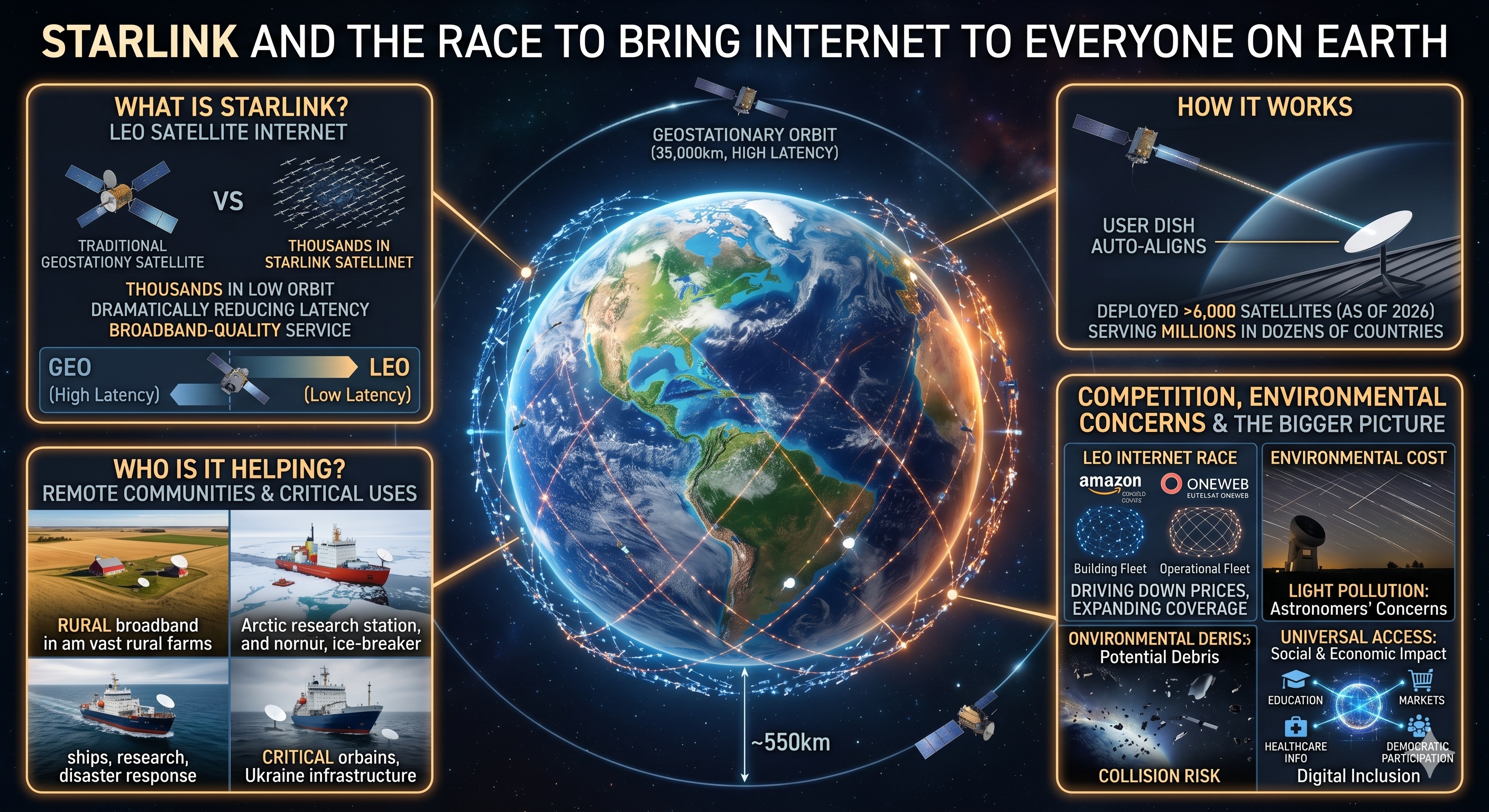
Starlink is SpaceX's satellite
internet service. Unlike traditional satellite internet — which used a small
number of satellites in high geostationary orbit, resulting in high latency —
Starlink deploys thousands of small satellites in low Earth orbit (LEO),
dramatically reducing latency and enabling broadband-quality service.
How It Works
Starlink satellites orbit at
approximately 550km altitude (compared to 35,000km for geostationary
satellites). Users receive a small dish that automatically aligns with
satellites passing overhead. As of 2026, Starlink has deployed over 6,000
satellites and serves millions of customers in dozens of countries.
Who Is It Actually Helping?
Starlink has been genuinely
transformative for rural and remote communities that previously had no access
to reliable broadband. Remote farms, research stations, ships at sea, and
disaster response teams have all benefited significantly. In Ukraine, Starlink
terminals became critical communications infrastructure during the conflict.
The Competition
Starlink's success has attracted
competitors. Amazon's Project Kuiper is building a rival LEO constellation.
OneWeb (now Eutelsat OneWeb) is operational with a smaller fleet. The
competition is driving down prices and expanding coverage — good news for global
connectivity.
The Environmental Concerns
The proliferation of satellite
constellations is raising serious concerns among astronomers. Thousands of
bright satellites create light pollution that interferes with ground-based
telescopes and disrupts dark sky observations. The risk of orbital debris and
satellite collisions is also a growing concern.
The Bigger Picture
Universal internet access is not
just a convenience issue — it has profound economic and social implications.
Connectivity enables access to education, markets, healthcare information, and
democratic participation. Satellite internet won't solve all barriers to
digital inclusion, but it's removing one of the most fundamental: physical
access.





Comments