
Electric Vehicles and the Tech Powering the Future of Transport
The internal combustion engine
dominated transportation for over a century. Now, driven by climate urgency and
breathtaking advances in battery technology, the electric vehicle is reshaping
the automotive industry at unprecedented speed.
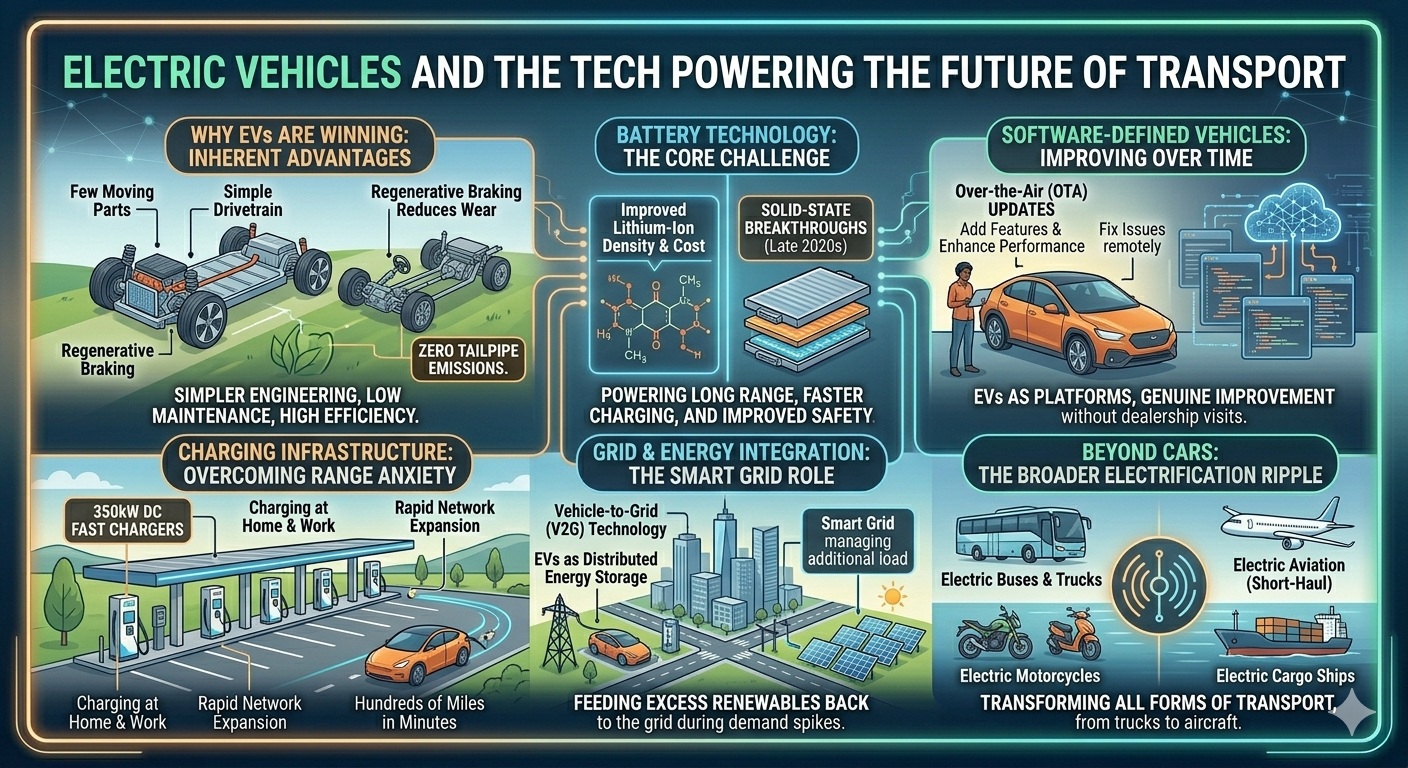
Why EVs Are Winning
Electric vehicles have inherent
engineering advantages over internal combustion vehicles. They have far fewer
moving parts — no oil changes, fewer brake replacements (regenerative braking
reduces wear), simpler drivetrains. They convert energy to motion more
efficiently. And they produce zero tailpipe emissions.
As battery costs have plummeted
and performance has improved, EVs have become genuinely competitive on price
and dramatically superior on running costs.
Battery Technology: The Core Challenge
Battery technology is the most
critical factor in EV advancement. Lithium-ion batteries have improved
dramatically in energy density, charging speed, and cost over the past decade.
Solid-state batteries — potentially offering higher energy density, faster
charging, and improved safety — are in development at multiple companies and
may begin appearing in production vehicles in the late 2020s.
Charging Infrastructure
Range anxiety — fear of running
out of charge — remains the most common consumer concern about EVs. Charging
infrastructure is expanding rapidly, but coverage remains uneven. Fast charging
technology has improved significantly, with 350kW DC fast chargers capable of
adding hundreds of miles of range in 15–20 minutes for compatible vehicles.
Software-Defined Vehicles
Modern EVs are essentially
software platforms on wheels. Over-the-air software updates can add new
features, improve performance, and fix issues without a dealership visit. Tesla
pioneered this approach; traditional automakers are rapidly following. The vehicle
you buy today can genuinely improve over time.
The Grid and Energy Integration
Widespread EV adoption has
implications for electricity grids. Vehicle-to-grid (V2G) technology allows EV
batteries to store excess renewable energy and feed it back to the grid when
demand spikes — potentially making EVs a distributed energy storage resource.
Managing the additional load from millions of charging EVs requires smart grid
infrastructure.
Beyond Cars
Electric technology is
transforming buses, trucks, motorcycles, aircraft, and ships. Electric aviation
is advancing rapidly for short-haul routes. Electric cargo ships are entering
service. The electrification of transport is broader than the car, and the
technology ripple effects will be felt across the entire transportation system.





Comments