
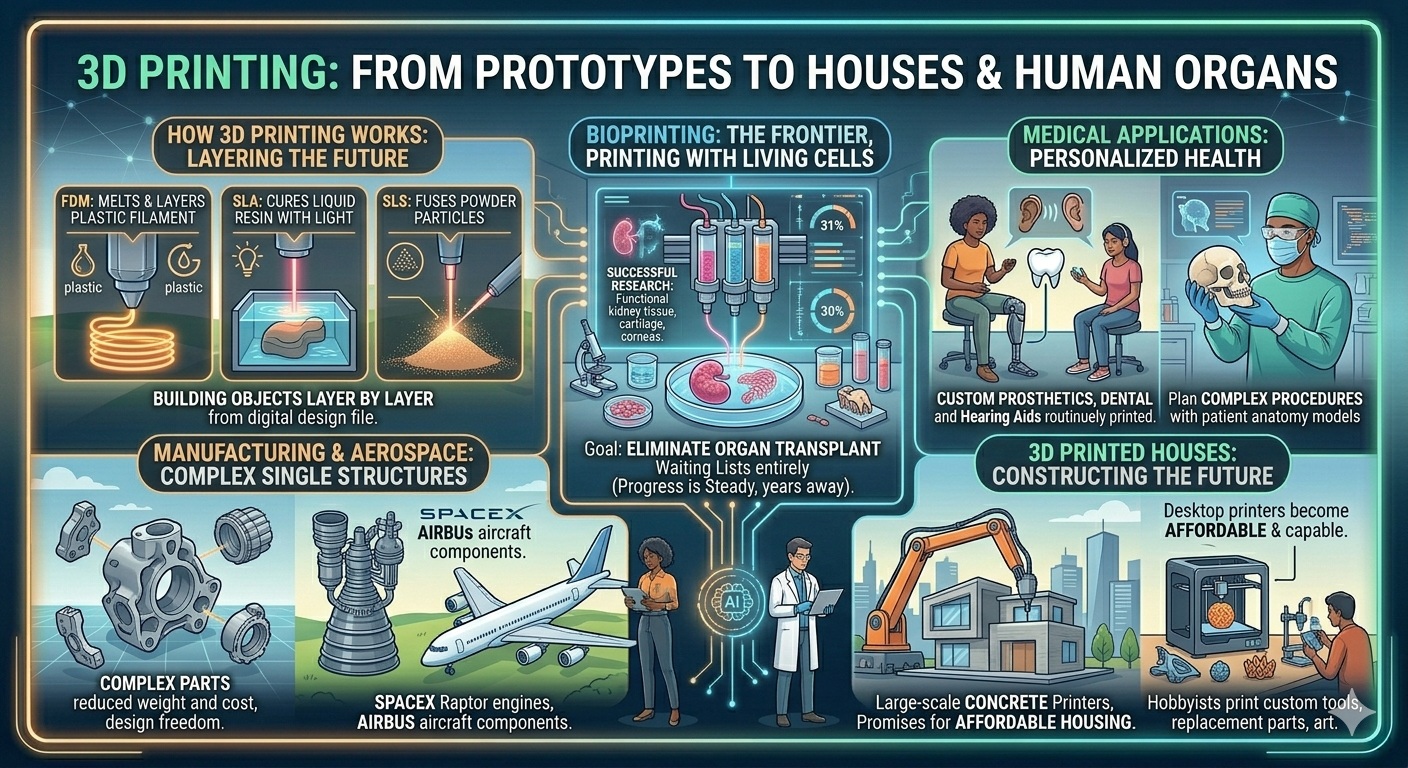
3D Printing: From Prototypes to Houses and Human Organs
3D printing — or additive
manufacturing — began as a tool for making prototypes. Thirty years later, it's
printing rocket engines, custom prosthetics, complex food, and, in research
settings, living human tissue. Few technologies have evolved so dramatically.
How 3D Printing Works
3D printing builds objects layer
by layer from a digital design file. Different technologies use different
materials and methods: FDM (Fused Deposition Modeling) melts plastic filament.
SLA (Stereolithography) cures liquid resin with light. SLS (Selective Laser
Sintering) fuses powder particles. Metal 3D printing melts and fuses metal
powder. Each approach has different capabilities and material properties.
Manufacturing and Aerospace
3D printing has transformed how
complex parts are manufactured. Components that previously required multiple
machined pieces assembled together can now be printed as a single, complex
structure. SpaceX uses 3D-printed components in Raptor engines. Airbus prints
parts for its aircraft. The weight savings and design freedom are significant.
Medical Applications
Medical 3D printing is advancing
rapidly. Custom prosthetics can be printed to match a patient's exact anatomy
at a fraction of the cost of traditional manufacturing. Dental crowns and
implants are routinely 3D printed. Surgeons use printed models of patient
anatomy to plan complex procedures. And hearing aids are almost universally
produced by 3D printing.
Bioprinting: The Frontier
Bioprinting — printing with
living cells — is among the most extraordinary areas of research. Scientists
have successfully printed functional kidney tissue, cartilage, and corneas in
laboratory settings. The goal of printing full transplantable organs remains
years away, but progress is steady. It could eventually eliminate organ
transplant waiting lists entirely.
3D Printed Houses
Construction 3D printing uses
large-scale concrete printers to build structures. Houses have been built in
days rather than months, at significantly reduced cost. The technology is
particularly promising for affordable housing and disaster relief construction.
Multiple companies are deploying 3D-printed housing projects globally.
Consumer 3D Printing
Desktop 3D printers have become
affordable and capable enough for home use. Hobbyists print replacement parts,
custom accessories, artistic objects, and functional tools. While the consumer
market hasn't yet reached mainstream adoption, falling prices and improving
ease of use are gradually expanding the user base.





Comments