
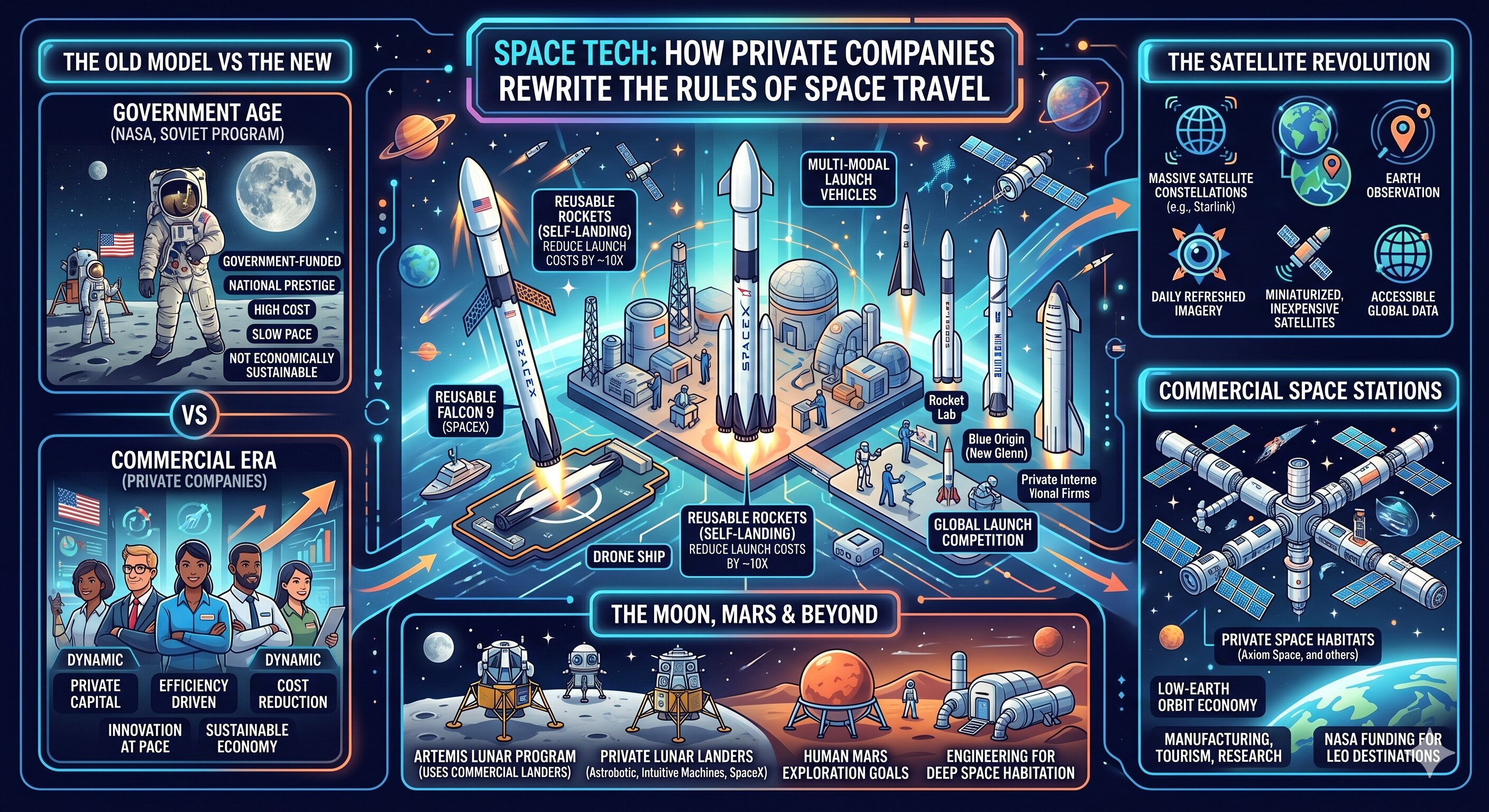
Space Tech: How Private Companies Are Rewriting the Rules of Space Travel
For most of its history, space
exploration was the exclusive domain of governments with vast national budgets.
That era is over. Private companies are now building rockets, satellites, and
space stations — and in the process, dramatically changing what's possible and
who gets to participate.
The Old Model vs the New
The original space age was
defined by government agencies — NASA, the Soviet space program — with
essentially unlimited political backing and national prestige on the line. Cost
was secondary to achievement. The result was extraordinary accomplishments, but
at extraordinary expense and in ways that weren't economically sustainable.
SpaceX Changes Everything
SpaceX, founded by Elon Musk in
2002, has been the most disruptive force in space history since the Apollo
program. The development of reusable rockets — the Falcon 9 booster that lands
itself back on a drone ship after launch — has reduced the cost of getting to
orbit by an order of magnitude. Starship, now operational, promises further
dramatic cost reductions.
The Proliferation of Launch Providers
SpaceX's success has inspired
dozens of new launch companies globally. Rocket Lab provides dedicated small
satellite launches. Blue Origin is developing its New Glenn rocket. Indian,
European, Japanese, and Chinese private companies are all competing. The result
is falling prices and increasing access.
The Satellite Revolution
Falling launch costs have
enabled a proliferation of satellites — for communications (Starlink), Earth
observation, weather monitoring, and navigation. A category of small,
inexpensive satellites is enabling applications that previously required
expensive government missions. Satellite imagery of the entire Earth is now
refreshed daily.
Commercial Space Stations
As the International Space
Station approaches end of life, NASA is funding private companies to develop
successor commercial space stations. Axiom Space is building modules to attach
to the ISS, eventually becoming a standalone station. Multiple companies are
competing to provide low-Earth orbit destinations after the ISS is retired.
The Moon, Mars, and Beyond
Private companies are targeting
the Moon — NASA's Artemis program uses commercial landers — and Mars. SpaceX's
explicit long-term goal is human settlement of Mars. Whatever one thinks of
that ambition, the engineering progress it's driving is real and remarkable.
The next chapter of space exploration is being written by entrepreneurs as much
as governments.





Comments