
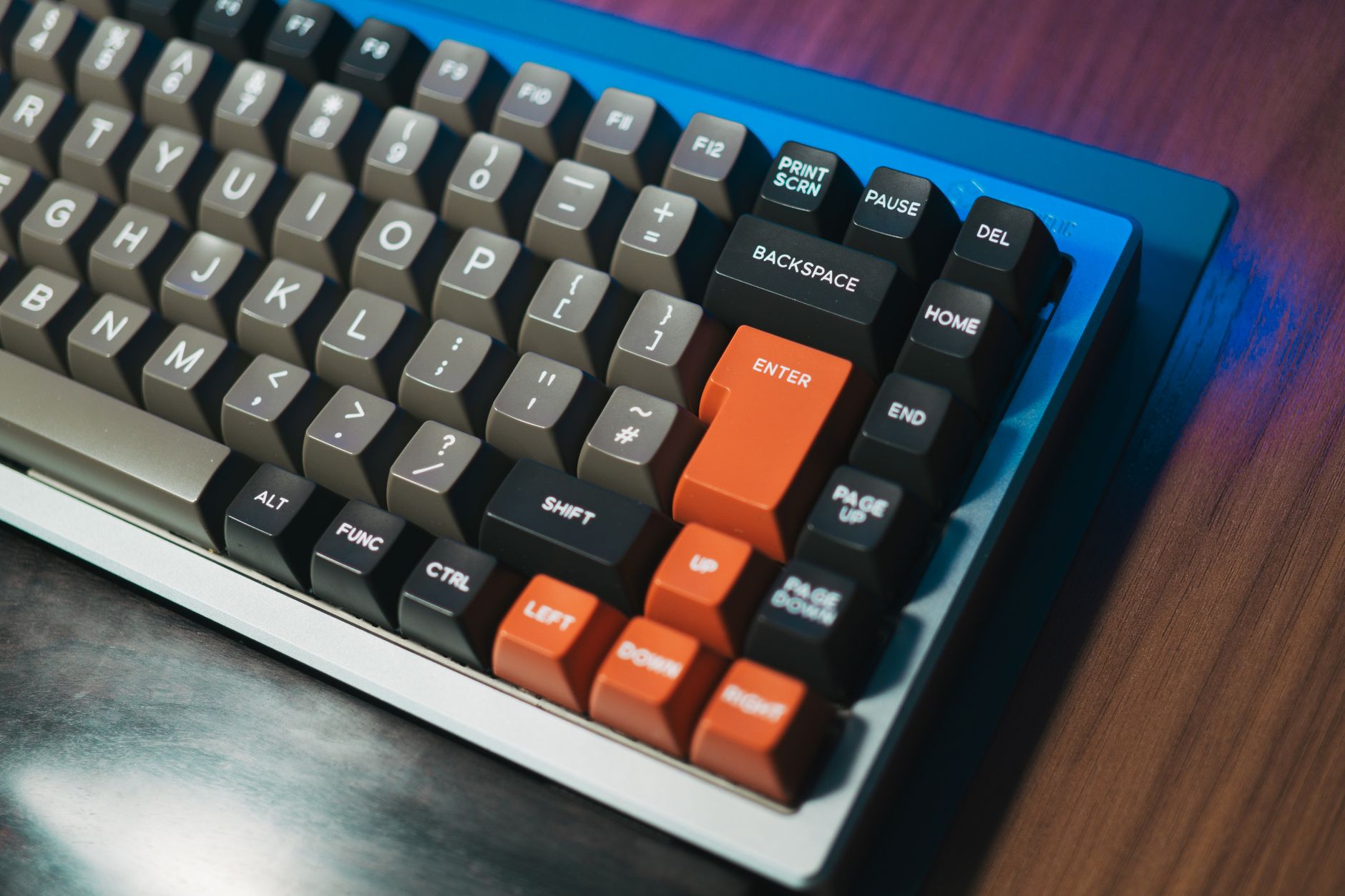
Building a custom computer keyboard usually involves soldering switches onto a single circuit board and accepting a fixed layout. A new open-source project called Keybytes aims to change that by treating individual keys much like Lego building blocks. Developed by MIT student Nathan Alspaugh, the system relies on magnetic connections and decentralized processing to let users snap together entirely custom input arrangements.
At the heart of the hardware are two primary components: the central Keyword controller and individual Keybit modules. Each Keybit measures 19.05 by 19.05 millimeters, matching a standard 1U keyboard unit. Four-sided pogo pin connections manage power and I2C communications, allowing the modules to link across multiple edges. Crucially, every Keybit contains its own RISC-V microcontroller, enabling individual keys to operate independently instead of routing everything through a single processor. The central Keyword module features stacked circuit boards housing an Arm Cortex-M4 microcontroller, a Bluetooth antenna, flash memory, and USB-C connectivity with a buck-boost converter for power management. Builders can drop in standard Cherry MX mechanical switches to achieve their preferred typing feel.
Despite the high degree of customization, the project remains in an early stage of development, with Alspaugh noting the system only recently achieved a functional state. Assembling a complete full-size layout requires roughly two Keyword controllers and 110 Keybits, bringing an estimated price tag near $900. Because every single key demands its own printed circuit board, electronic components, and microcontroller, costs scale up quickly compared to conventional hardware. Builders also need to factor in soldering, component sourcing, and custom 3D-printed enclosures.
Current limitations include a lack of dedicated per-key illumination, with lighting currently restricted to a status indicator on the main Keyword unit. Alspaugh has published all design assets, project files, and construction details on GitHub under an MIT license, giving hardware enthusiasts the freedom to modify and build their own units. Proposed upgrades for future iterations include rotary controls, fingerprint recognition modules, customizable RGB lighting, and compatible touchpads, though these remain concepts rather than confirmed features.





Comments