
For thousands of years, medicine was an art of observation, trial, and error. A physician’s greatest tools were their eyes, ears, and hands, supplemented by whatever rudimentary tools the era could provide. Today, that paradigm has violently shifted. We have entered an era where medicine is a data science problem, a robotics challenge, and an exercise in deep learning. The integration of cutting-edge technology into healthcare is no longer just about improving administrative efficiency; it is fundamentally altering human longevity, transforming how diseases are diagnosed, and redefining the very nature of treatment.
From artificial intelligence algorithms that can read radiological scans faster and more accurately than the human eye, to robotic surgical arms that remove tumors with sub-millimeter precision, the medical sector is currently undergoing the most aggressive technological renaissance in human history. To understand the magnitude of this shift, we must break down the core technologies driving the hospital of the future.
Artificial Intelligence: The New Diagnostician
The sheer volume of medical data generated daily is staggering. A single patient’s electronic health record, genomic profile, and imaging history can comprise gigabytes of data. The human brain, no matter how highly trained, cannot synthesize millions of data points simultaneously. Artificial Intelligence (AI), however, thrives on it.
- Radiology and Pathology: Deep learning algorithms are now routinely deployed to screen for anomalies. AI systems are trained on millions of annotated images—X-rays, MRIs, and CT scans—learning to identify the faint, pixel-level patterns that indicate the early stages of lung cancer, diabetic retinopathy, or cerebral hemorrhages.
- Predictive Analytics: AI is used in intensive care units to forecast patient deterioration hours before a human clinician would notice subtle physiological changes. By constantly analyzing vital signs, AI can alert a rapid response team to an impending sepsis crash or cardiac event.
- Drug Discovery: In the realm of biopharmaceuticals, AI drastically reduces the time it takes to discover new drugs. By simulating molecular interactions and predicting how compounds will bind to target proteins, AI can cut a process that traditionally took a decade down to a matter of months.
Robotic Surgery: Precision Beyond Human Hands
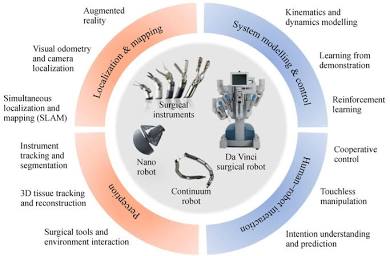
If AI is the brain of modern healthcare, advanced robotics are its hands. The concept of robotic surgery has existed for over two decades, but the capabilities of these machines have evolved exponentially. Modern surgical robots do not operate autonomously; they are highly sophisticated extensions of the surgeon’s own hands.
Sitting at a console, a surgeon views a highly magnified, high-definition 3D image of the surgical site. The robot translates the surgeon's hand, wrist, and finger movements into precise, micro-movements of miniaturized instruments inside the patient.
- Enhanced Dexterity: Robotic arms possess seven degrees of freedom—greater than the human wrist—and are entirely immune to natural hand tremors.
- Patient Outcomes: This allows for incredibly delicate procedures with minimal collateral tissue damage. For the patient, this translates to smaller incisions, significantly reduced blood loss, lower risk of infection, and a vastly accelerated recovery time.
- Telesurgery: Looking toward the horizon, the integration of 5G networks and haptic feedback is paving the way for remote surgery, where an expert surgeon in New York could operate on a patient in a rural clinic thousands of miles away in real-time.
Telemedicine and The Decentralized Hospital
The concept of the hospital as a centralized monolith is slowly dissolving. Telemedicine has evolved from simple video calls into a robust, decentralized care ecosystem, democratizing access to care globally.
- Continuous Remote Monitoring: Devices can now monitor continuous glucose levels, track electrocardiograms (ECGs) to detect atrial fibrillation, measure blood oxygen saturation, and monitor respiratory rates.
- Proactive Chronic Care: This continuous stream of physiological data allows doctors to manage chronic diseases proactively, rather than relying on episodic check-ups every few months.
- Advanced Diagnostic Peripherals: Primary care physicians can conduct comprehensive physical exams from miles away using peripherals that connect to smartphones, such as digital stethoscopes, otoscopes, and high-resolution skin cameras.
Genomics and Personalized Medicine
Perhaps the most profound shift in modern medicine is the move away from the "one-size-fits-all" approach to treatment, made possible by massive advancements in genomic sequencing. Today, a human genome can be sequenced in a matter of hours for less than $300, birthing the era of personalized medicine.
- Pharmacogenomics: Doctors can look at a patient’s specific genetic makeup to determine how they will respond to specific medications, maximizing efficacy and reducing adverse side effects.
- Tumor Profiling: In oncology, rather than treating cancer with broad-spectrum chemotherapy, oncologists sequence the DNA of the tumor itself. By identifying the specific genetic mutations driving the cancer, they prescribe targeted biologic therapies.
- Gene Editing: Technologies like CRISPR-Cas9 act as "molecular scissors," editing defective genes directly within a patient's body to cure inherited genetic disorders like sickle cell anemia.
3D Printing: Bioprinting and Anatomical Models
Additive manufacturing has found incredibly vital applications in the healthcare sector, moving from structural tools to actual biological applications.
- Surgical Planning: Hospitals use 3D printers to create patient-specific anatomical models based on MRI data. Surgeons can map out complex procedures—like separating conjoined twins—and practice their approach before the first incision.
- Bioprinting: Scientists are developing 3D printers that use "bio-inks" comprised of living human cells. Researchers are successfully bioprinting cartilage, skin tissue for burn victims, and organoid structures for drug testing.
The Outlook
We are moving from a system of reactive sick-care to one of predictive, personalized, and preventive health. Technology in healthcare is no longer just a set of tools; it is the very foundation upon which the future of human longevity is being built.





Comments