
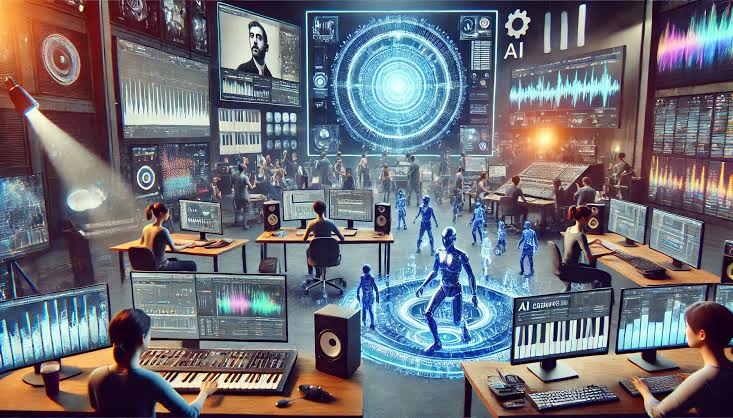
For a century, the creation of entertainment—whether film, music, or television—relied on massive physical infrastructure, rigid production schedules, and the sheer luck of capturing the perfect moment on camera or tape. Today, the boundary between reality and computer-generated synthesis is not just blurring; it has practically vanished. The entertainment and media sectors are undergoing a rapid transformation driven by generative artificial intelligence, real-time rendering, and hyper-personalized distribution algorithms.
We are moving from an era of "capturing" media to "computing" it. Technology is democratizing the tools of creation while simultaneously scaling the quality of output to unprecedented levels, fundamentally altering how stories are told and consumed.
Virtual Production and The Death of the Green Screen
The iconic green screen, long a staple of visual effects (VFX), is being rapidly replaced by "The Volume"—massive, high-definition LED walls combined with game-engine technology.
- Real-Time Rendering: Using software like Unreal Engine, studios project hyper-realistic, 3D computer-generated environments onto LED screens surrounding the actors. The camera is tracked in 3D space, meaning that when the physical camera moves, the digital background shifts with perfect parallax in real-time.
- In-Camera Visual Effects (ICVFX): Directors no longer have to guess what a scene will look like after months of post-production. The actors can see the alien landscape or the burning cityscape they are reacting to, and the lighting from the LED screens casts perfect, natural reflections onto physical props and costumes.
- Location Independence: A production crew can shoot a sunrise scene in the Sahara Desert in the morning and a nighttime shootout in Tokyo in the afternoon, all without ever leaving a soundstage in Los Angeles. This drastically reduces carbon footprints, travel costs, and production timelines.
Generative AI: The Ultimate Co-Creator
Artificial intelligence is transitioning from a backend recommendation tool into an active participant in the creative process, touching every phase of production.
- Scripting and Pre-Production: Writers and directors use Large Language Models (LLMs) to brainstorm plot points, generate character dialogue variations, and instantly create thousands of storyboards from text prompts. It is not replacing the human writer, but acting as a tireless, high-speed sounding board.
- Synthetic Voice and Audio: AI can clone a specific actor's voice with only a few minutes of training data. If an actor mumbles a line on set, the director no longer needs to bring them back weeks later for Automated Dialogue Replacement (ADR); the AI can seamlessly generate the corrected audio in their exact cadence and tone.
- De-Aging and Digital Doubles: Machine learning algorithms can analyze decades of an actor's filmography to flawlessly de-age them in real-time, or create fully synthetic "digital doubles" to perform incredibly dangerous stunts, pushing the boundaries of visual storytelling.
Algorithmic Curation and The Attention Economy
In an era of infinite content, the most valuable asset a media company has is not its catalog, but its algorithm.
- Hyper-Personalized Feeds: Platforms like TikTok and Netflix do not just host content; they serve it through hyper-optimized neural networks. These algorithms analyze micro-behaviors—how long you hover over a thumbnail, the exact second you skip a song, the color palettes of the movies you finish—to construct a psychological profile of your tastes.
- Dynamic Packaging: Streaming services will dynamically change the promotional artwork for the same movie based on who is looking at it. If the algorithm knows you love romance, it will show you a thumbnail of the two leads kissing; if you love action, it will show you the same movie but feature an explosion as the artwork.
- Predictive Commissioning: Studios use data analytics to reverse-engineer hit shows. By analyzing search trends, completion rates, and genre overlap, they can identify underserved niches and greenlight projects with a statistically guaranteed built-in audience before the script is even written.
Immersive Gaming and Spatial Computing
The video game industry, now significantly larger than the global box office and music industry combined, is the bleeding edge of interactive entertainment.
- Cloud Gaming: Technology is decoupling high-end gaming from expensive hardware. Cloud gaming renders graphically intense games on massive server farms and streams the video directly to a smart TV or low-end laptop in milliseconds, relying heavily on 5G and edge computing to eliminate input latency.
- Neural Rendering and Ray Tracing: Modern games simulate the physical behavior of light. Ray tracing calculates exactly how a single photon bounces off water, reflects onto a wall, and enters the virtual camera lens, creating photorealistic environments that rival Hollywood blockbusters.
- Spatial Audio: Sound design has moved beyond simple left/right stereo channels. Object-based spatial audio (like Dolby Atmos) treats every sound—a helicopter flying overhead, a footstep behind you—as an independent 3D object mapped to your exact physical space, creating terrifyingly immersive acoustic environments.
The Outlook
The future of entertainment is synthetic, personalized, and interactive. As the friction between imagination and execution drops to zero, the defining metric of success in media will no longer be budget or distribution power, but sheer creative vision.





Comments