
Despite being one of the largest sectors of the global economy, construction has historically been one of the least digitized. For decades, productivity in construction remained flat—or even declined—while manufacturing and agriculture saw massive technological efficiency gains. The industry was plagued by cost overruns, safety hazards, supply chain opacity, and a heavy reliance on fragmented, manual labor.
That era is rapidly coming to an end. A massive convergence of software and hardware is turning the chaotic, unpredictable construction site into a precise, automated manufacturing operation. From the architect's initial digital model to the autonomous robots laying bricks on the site, technology is fundamentally rebuilding how we create the built environment.
Building Information Modeling (BIM)
The days of rolling out physical 2D blueprints on the hood of a truck are over. Building Information Modeling (BIM) is the digital backbone of modern construction.
- Beyond 3D: BIM is not just a 3D visualization; it is a highly intelligent database. Every door, pipe, and steel beam in a BIM model contains metadata about its physical properties, cost, and installation schedule.
- Clash Detection: In the past, the plumbers and electricians might arrive on site only to realize their plans physically intersected, causing massive delays. BIM allows software to automatically run "clash detection" in the virtual model, resolving these physical conflicts months before the first shovel hits the dirt.
- 4D and 5D Modeling: Advanced BIM integrates the dimension of time (4D) to visualize the construction sequence week by week, and the dimension of cost (5D) to automatically update the project budget in real-time as material prices fluctuate or designs change.
3D Printed Buildings and Prefabrication
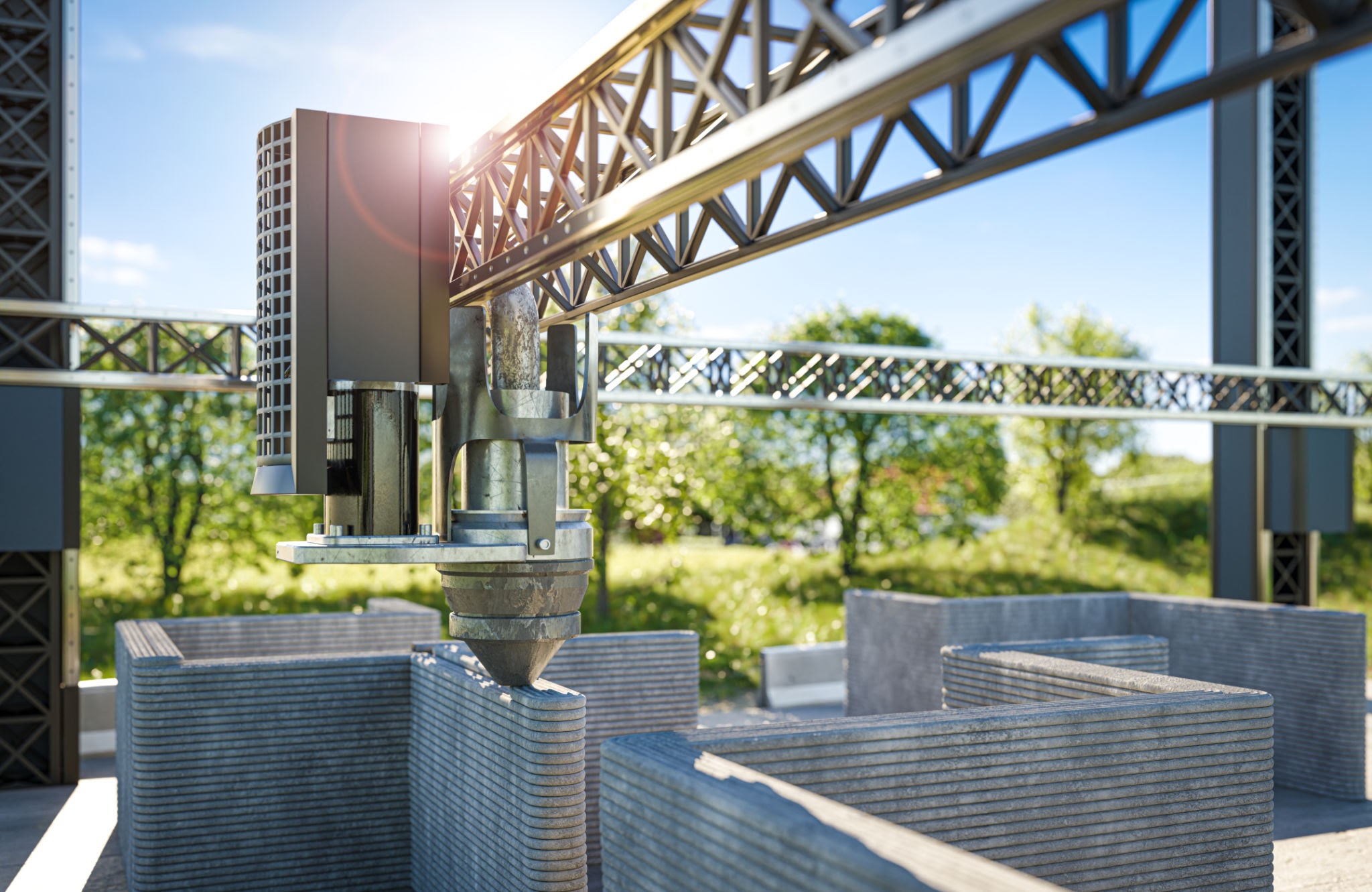
Additive manufacturing is scaling up from printing small plastic prototypes to printing entire houses.
- Concrete 3D Printing (Contour Crafting): Massive gantry-style robots or robotic arms on tracks extrude specialized, fast-curing concrete layer by layer based on a digital CAD file. This technology can print the structural walls of a house in a matter of days, drastically reducing labor costs, eliminating formwork waste, and allowing for complex, curved architectural designs that would be too expensive to build traditionally.
- Off-Site Modular Construction: Construction is moving toward a manufacturing model. Entire hospital rooms or apartment units—complete with plumbing, wiring, and painted walls—are built in climate-controlled factories using automated assembly lines. These modules are then shipped to the site and stacked like Lego bricks, cutting project timelines by up to 50% and protecting the project from weather delays.
Drones and Autonomous Surveying
The sheer scale of a commercial construction site makes it incredibly difficult to monitor accurately. Aerial and ground-based robotics provide a real-time, objective source of truth.
- Daily Aerial LiDAR Scans: Drones equipped with high-resolution cameras and LiDAR fly over the site daily to create an exact 3D point-cloud map of the terrain.
- Digital Twin Verification: AI software compares the drone's daily physical scan against the original BIM model to automatically verify progress. If a concrete foundation is poured two inches out of alignment with the digital blueprint, the system flags it instantly, preventing the error from compounding as the building goes up.
- Autonomous Heavy Machinery: Companies are retrofitting traditional bulldozers and excavators with GPS, computer vision, and autonomous software. These machines can perform repetitive earthmoving tasks—like grading a site to a precise angle or digging a perfectly straight trench—without a human operator in the cab.
Augmented Reality on the Job Site
AR bridges the gap between the digital BIM model and the messy reality of the physical construction site.
- X-Ray Vision for Workers: Using industrial AR headsets (like the Microsoft HoloLens integrated into hardhats), a worker can look at a blank concrete wall and see exactly where the HVAC ducts and electrical conduits are supposed to run behind it, overlaid perfectly in 3D space.
- Remote Inspection: An inspector or lead architect in another country can log into the headset of a site manager, seeing exactly what they see in real-time, pointing out issues, and signing off on milestones without having to travel to the physical site.
Advanced Smart Materials
Technology is not just changing how we build; it is changing what we build with.
- Self-Healing Concrete: Concrete cracks are inevitable and lead to structural degradation. Scientists have embedded dormant bacteria and starch into concrete mixes. When a crack forms and water enters, the bacteria wake up, consume the starch, and excrete limestone, automatically sealing the crack from the inside without human intervention.
- Phase-Change Materials (PCMs): Building materials are being infused with PCMs that absorb and release thermal energy. As a room heats up during the day, the material absorbs the heat (melting internally). As it cools down at night, it releases the heat back into the room (solidifying), drastically reducing the load on traditional HVAC systems.
The Outlook
The construction industry is transitioning from a fragmented, manual trade into a highly integrated, data-driven manufacturing process. By leveraging digital twins, robotics, and advanced materials, the architecture and construction sectors are poised to build safer, cheaper, and vastly more sustainable cities for the future.





Comments