
For centuries, government administration was synonymous with bureaucracy—endless paper trails, physical waiting lines, and siloed departments that rarely communicated with one another. The relationship between the citizen and the state was largely transactional and highly inefficient. Today, Government Technology (GovTech) is fundamentally restructuring how the public sector operates, aiming to make government services as seamless, personalized, and accessible as the best consumer e-commerce platforms.
This transformation goes far beyond simply moving paper forms to PDF files. GovTech is about leveraging digital identity, data interoperability, and smart urban infrastructure to create a proactive, invisible state that anticipates citizen needs and optimizes public resources in real-time.
Digital Identity and the e-State
The foundation of any digital government is a secure, verifiable digital identity. Without it, citizens cannot interact with government services securely online.
- The Estonian Model: Estonia is widely considered the most advanced digital society in the world. Every citizen receives a cryptographic digital ID card at birth. Through their "X-Road" data exchange platform, 99% of state services are online. Citizens can vote, file taxes in minutes, check medical records, and register a business entirely digitally.
- Decentralized Interoperability: In modern GovTech, government departments do not hoard duplicate data. If a citizen updates their address with the postal service, the X-Road protocol automatically updates their driver's license, tax records, and voter registration simultaneously. The citizen never has to provide the same piece of information to the government twice.
- Biometric Integration: Massive national identity programs, such as India's Aadhaar, have registered the biometric data (fingerprints and iris scans) of over a billion people. This allows the government to distribute welfare subsidies and food rations directly to the intended recipient's bank account, drastically cutting down on systemic corruption and "ghost" beneficiaries.
Smart City Infrastructure and IoT
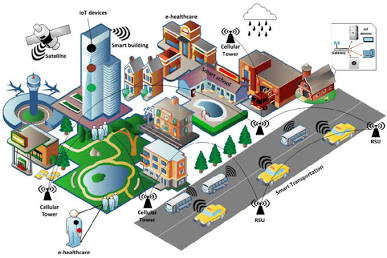
As urban populations explode, managing the physical infrastructure of a city requires more than pouring concrete. Smart cities use the Internet of Things (IoT) to turn the built environment into a responsive, data-generating network.
- Dynamic Traffic Management: Legacy traffic lights operate on rigid, timed loops. Smart intersections use computer vision and radar to analyze the real-time flow of cars, bicycles, and pedestrians. AI algorithms dynamically adjust the light timing across the entire city grid to ease congestion, prioritize approaching ambulances, and reduce idling emissions.
- Predictive Utilities: IoT sensors attached to municipal water mains listen for the specific acoustic signature of micro-leaks, allowing city engineers to repair pipes before a catastrophic water main break occurs. Similarly, smart streetlights equipped with ambient light sensors and motion detectors only illuminate when pedestrians or cars are present, slashing municipal energy costs.
- Waste Management Optimization: Trash bins equipped with ultrasonic fill-level sensors alert sanitation departments exactly when they need to be emptied. Instead of driving rigid, inefficient daily routes, garbage trucks receive dynamic, algorithmically optimized routes each morning, picking up only the bins that are actually full.
Blockchain for Civic Transparency
Trust in public institutions has been steadily declining globally. GovTech utilizes blockchain technology to inject cryptographic transparency and immutability into government operations.
- Immutable Land Registries: In many developing nations, property rights are plagued by fraudulent paper deeds and corrupt record-keeping. By moving the national land registry to a blockchain, ownership records become immutable. A citizen's claim to their land cannot be altered, deleted, or forged by a corrupt official, establishing the secure property rights necessary for economic growth.
- Transparent Procurement: Government contracting is historically opaque. Blockchain-based procurement platforms track every dollar of taxpayer money spent on a public project. Citizens can trace exactly which vendor received a contract, when the funds were released, and verify the delivery of materials on a public ledger, making financial mismanagement nearly impossible to hide.
AI in Public Services and Triage
Governments are the largest customer service organizations in the world, often overwhelmed by the sheer volume of citizen requests.
- Automated Social Services: AI is being deployed to assess eligibility for social benefits. Natural Language Processing (NLP) models can read through complex application narratives and cross-reference them with tax and employment databases to instantly approve food assistance or unemployment claims, reducing processing times from weeks to seconds.
- Predictive Policing and Resource Allocation: While highly controversial and requiring strict ethical oversight, police departments use predictive analytics to map historical crime data, weather patterns, and local events to forecast where crimes are statistically most likely to occur, allowing them to proactively deploy patrols to those specific micro-grids to deter illicit activity.
The Outlook
The ultimate goal of GovTech is the "invisible state"—a government that works so efficiently in the background that citizens rarely have to consciously interact with it. By securing digital identities and integrating smart infrastructure, the public sector is evolving to deliver proactive, data-driven governance that matches the speed and convenience of the modern digital world.





Comments