
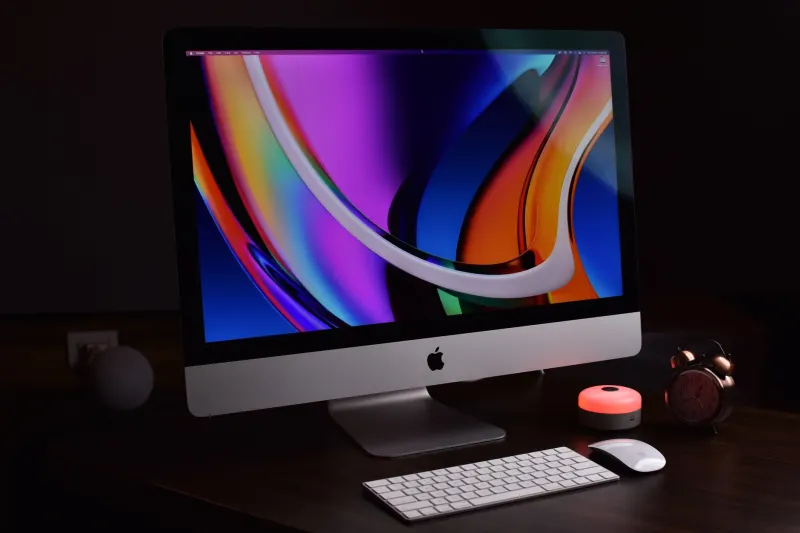
Apple has released its latest 24-inch all-in-one desktop featuring the new M6 processor, maintaining the familiar design language of its predecessor while introducing modest internal upgrades. Starting at $1,499, the base model provides basic performance suitable for daily tasks, but requires users to navigate a steep pricing structure for configurations that include necessary ports and storage. Review units highlighted solid screen and sound quality, alongside improved SSD read and write speeds that significantly outpace older M-series hardware.
Key takeaways
- The base M6 iMac starts at $1,499 with a paltry 256GB SSD and requires extra spending for more ports and CPU cores.
- New SSD architecture enables blisteringly fast write speeds exceeding 6,500 MB/s and read speeds over 5,800 MB/s.
- The M6 chip delivers a 20 percent performance boost in Cinebench 2026 and handles 1440p gaming capably.
- Running local AI models is restricted by the default 16GB of unified memory limitation.
Performance and Processing Capabilities
The updated M6 processor inside the new iMac comes in two distinct configurations, with the base model housing a 10-core CPU and 10-core GPU. A step-up version starting at $1,699 utilizes a 12-core CPU and 12-core GPU layout alongside four Thunderbolt 4 ports. In Geekbench 6 testing, the upgraded iMac scored 39 percent better than the Geekom A9 Max featuring an AMD Ryzen AI 9 HX 470 chip. Furthermore, Handbrake video transcoding tests saw the M6 finish a 4K to 1080p conversion in 1 minute and 30 seconds flat.
Real-time rendering benchmarks like 3DMark Steel Nomad show the new M6 GPU achieving scores up to 45 percent higher than previous hardware iterations. Gamers can expect capable 1440p performance, running titles like Control and Baldur's Gate III at around 40 to 43 frames per second, which scales to 60 fps using MetalFX upscaling. Demanding titles like Resident Evil 4 ran at 50 to 60 fps in outdoor areas without upscaling, though frame rates occasionally dipped into the 40s during intense arenas.
Display, Connectivity, and Hardware Limitations
The desktop retains its 24-inch Retina LCD screen with a 4,480 x 2,520 resolution and 218 PPI pixel density, surrounded by large bezels. A 12-megapixel Center Stage webcam sits in a hole punch above the display, offering clear video quality even in low-light conditions. Connectivity receives a boost via the Apple N1 chip, enabling Wi-Fi 7 and Bluetooth 6, though the 2.5Gb Ethernet port remains inconveniently located on the power brick. The system also supports dramatically faster file loading thanks to SSD write speeds hitting 6537.9 MB/s and read speeds reaching 5836.0 MB/s in Blackmagic tests.
Physical design constraints remain a persistent hurdle. The device offers seven distinct colorways with matching accessories, but lacks front input/output ports or Thunderbolt 5 support. The headphone jack remains positioned awkwardly on the left flank, and the iconic Magic Mouse continues to draw criticism for its charging port placement and lack of a separate right-click button. Additionally, running local AI models like open-source 27B parameters is constrained by the default 16GB of RAM, necessitating upgrades to 24GB or 32GB for optimal performance.






Comments