
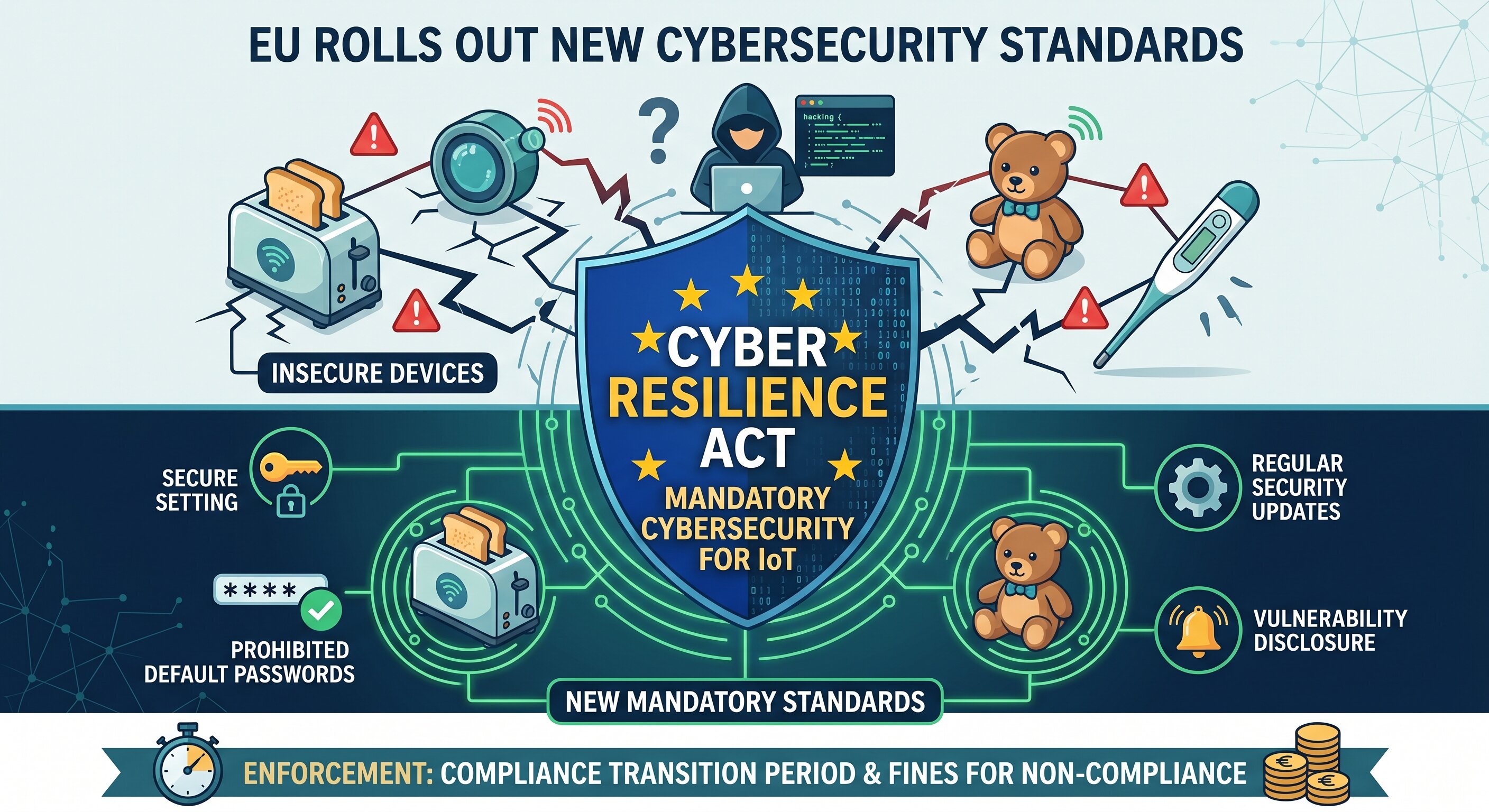
EU Rolls Out New
Mandatory Cybersecurity Standards for IoT Devices
Category:
Policy, Regulations & Industry
The European
Union has officially enacted the Cyber Resilience Act, introducing mandatory
cybersecurity standards for all Internet of Things devices sold in the EU
market. The landmark regulation represents the most comprehensive attempt by
any major jurisdiction to address the systemic cybersecurity risks posed by the
proliferation of poorly secured connected devices.
Under the new
rules, manufacturers of IoT devices — including smart home appliances,
wearables, industrial sensors, and networked toys — must meet minimum security
requirements before their products can be sold in the EU. These requirements
include implementing secure default settings, prohibiting universal default
passwords, providing regular security update support throughout the device's
expected lifetime, and disclosing vulnerabilities within defined timeframes.
"This is
a watershed moment for IoT security in Europe and potentially the world,"
said EU cybersecurity commissioner Elena Kovač. "For too long, the costs
of insecure devices have been externalized to consumers and society. This
regulation puts the responsibility where it belongs — with the
manufacturers."
The
regulation gives manufacturers a transition period to comply, but enforcement
will include market access restrictions and substantial fines for
non-compliance. Industry groups representing device manufacturers have broadly
welcomed the regulation, while noting that compliance will require significant
investment in product development processes.
Cybersecurity
experts are praising the regulation as a long-overdue step but are cautioning
that enforcement will be critical to its effectiveness. Some are also calling
on other major economies, including the United States and the United Kingdom,
to implement similar standards to prevent manufacturers from selling compliant
products in the EU and insecure versions elsewhere.





Comments